Give your favorite AI on whatever level of thinking / reasoning the following image with the following prompt. See the Findings section at the end for what happened on my end. More puzzles on the HexSum website.
The Image
The Prompt
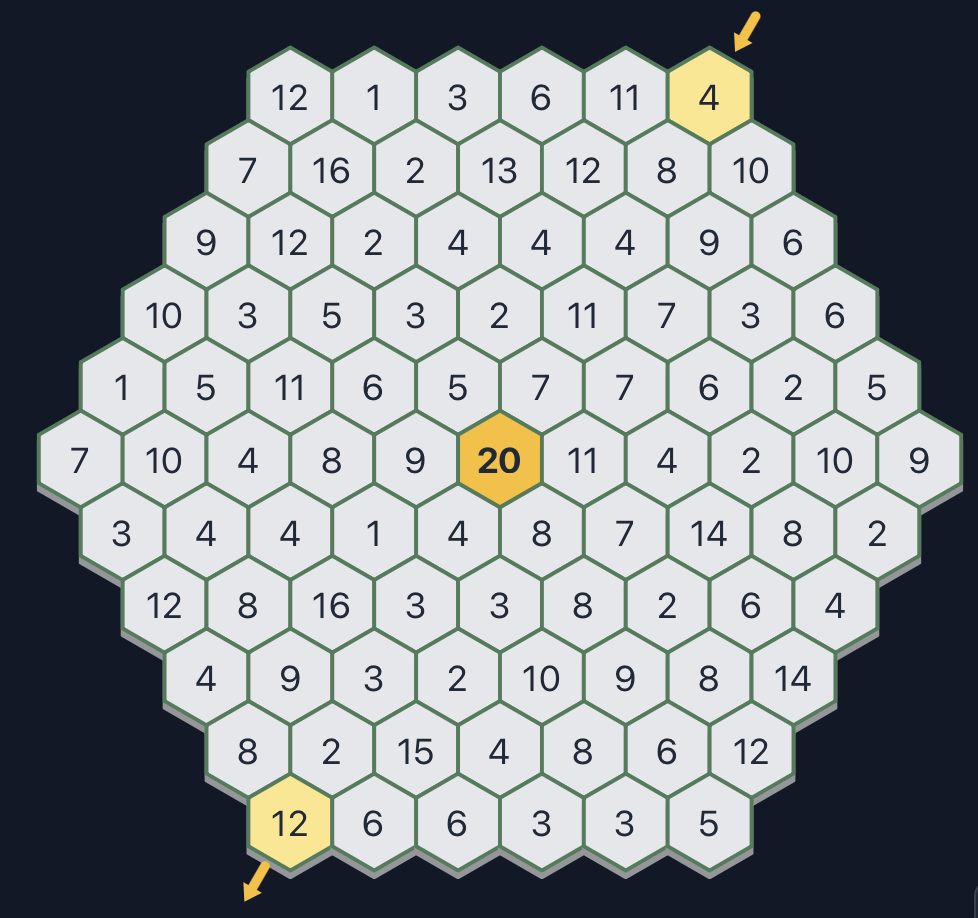
The image is a number game puzzle. The puzzle is setup as a radius-5, hex-tiled, honeycomb patterned board. Reading from left-to-right and top-to-bottom the values are
[12, 1, 3, 6, 11, 4]
[7, 16, 2, 13, 12, 8, 10]
[9, 12, 2, 4, 4, 4, 9, 6]
[10, 3, 5, 3, 2, 11, 7, 3, 6]
[1, 5, 11, 6, 5, 7, 7, 6, 2, 5]
[7, 10, 4, 8, 9, 20, 11, 4, 2, 10, 9]
[3, 4, 4, 1, 4, 8, 7, 14, 8, 2]
[12, 8, 16, 3, 3, 8, 2, 6, 4]
[4, 9, 3, 2, 10, 9, 8, 14]
[8, 2, 15, 4, 8, 6, 12]
[12, 6, 6, 3, 3, 5]
The puzzle is a maze where we enter the maze at the top-right hex (the entrance hex (colored yellow with a value of 4)) and leave from the bottom-left hex (the exit hex (colored yellow with a value of 12)), as indicated by the arrows.
The goal is to fill the board with a chain of paths with the following constraints:
(1) each path is a sequence of adjacent hexes whose values sum to the target number on the center hex (in this case, the center hex has a value of 20);
(2) the first path begins on the entrance hex, and every subsequent path begins on a hex adjacent to the last hex of the previous path;
(3) the center hex is impassable and is not used;
(4) all hexes (with the exception of the center hex) must be used exactly once;
(5) the exit hex must be the final hex of the final path.
Can you find a solution to this puzzle? Report your answer by stating the sequence of paths by giving the path number, the path values, and the path coordinates on three separate lines followed by an empty line. The coordinates are given by the row index and the in-row column index. For example, the first row of [12, 1, 3, 6, 11, 4] would have coordinates of [(1,1), (1,2), (1,3), (1,4), (1,5), (1,6)]. The second row of [7, 16, 2, 13, 12, 8, 10] would have coordinates of [(2,1), (2,2), (2,3), (2,4), (2,5), (2,6), (2,7)]. The center hex with value of 20 has coordinate (6,6). A possible first path that sums to 20 could be [4, 10, 6] with coordinates [(1,6), (2,7), (3,8)]. If this path were chosen as the first path, the next path must begin from a hex adjacent to (3,8); namely (3,7), (4,8), or (4,9).
Before attempting a solve, ask questions if there are any ambiguities in the instructions. If there are no ambiguities, attempt a solution. If no solution can be found, then report back that no solution can be found.
Findings
Fable 5.1, in the web chat, can solve this. It wrote a C program and returned a valid solution. ChatGPT in the web chat gave up, but I think it’s because it timed out [I don’t have full, unlimited plans for every AI / LLM out there]. So, it’s possible that OpenAI / ChatGPT can solve it with a better model.
Neither Fable nor ChatGPT complained about the instructions / prompt. But if you do run this, it is important to keep the prompt as given to rule out the prompt as a variable.
More Puzzles
If you want to create more puzzles like this, go to HexSumGame.com and click on New Game. Then click on Maze. You may need an account, which looks to be cheap and just a one-time payment. So it’s not a subscription or anything.
